|
|

Basic Music Notation
Note Values |

This is a - whole note
It is equal to 4 beats |

This is a - dotted half note
It is equal to 3 beats |

This is a - half note
It is equal to 2 beats |

This is a - quarter note
It is equal to 1 beat |
It's like pie. A whole pie has four quarters.
A whole note has four quarter notes |
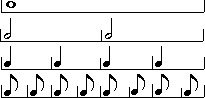
Rhythm Diagram:
-
A Whole Note has four beats. As you can see in the diagram above (the top line) it is the longest held note. It looks like a hollow oval with no stem. A whole note usually takes up a whole measure. A whole note would be counted: 1, 2, 3, 4.
-
Next in our diagram, we have Half Notes (second line down). They are a hollow oval with a stem and are held for two beats. Half Notes would be counted: 1, 2. A common measure has two of them.
-
The third line down shows Quarter Notes. They have one beat each and look like a solid oval with a stem. In a common measure, you can fit four Quarter Notes.
-
The last line shows Eighth Notes. Eighth notes are quite fast and look like a solid oval with a stem and tail. You can fit two Eighth Notes in one count. They only take up half of a beat each. To count them you would say: 1 & 2 & 3 & 4 &. This allows you to have a count for the notes that fall in between the beats. A common measure has eight of them.
Rest Values |
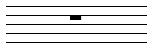
This is a - whole rest
It is equal to 4 beats |
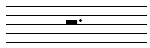
This is a - dotted half rest
It is equal to 3 beats |
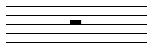
This is a - half rest
It is equal to 2 beats |
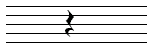
This is a - quarter rest
It is equal to 1 beat |
The rests work the same way as the rhythm diagram above.
A Rest is a silent beat. Like a note, each rest looks different.
As shown above, a Whole Rest is four beats long. The whole rest looks like a man hole cover. It is found ‘hanging’ from the fourth line up. It takes up a whole common measure and would be counted: 1, 2, 3, 4.
A Dotted Half Rest is equal to three beats. It looks like a dark rectangle with a dot beside it. A dotted half rest is counted: 1, 2, 3.
A Half Rest (as shown above) is two beats long. The half rest looks like a top hat. It is found on the third line up. It takes up half of a common measure and would be counted: 1, 2.
A Quarter Rest is one beat long. They take up a quarter of a common measure. They look like a lightning bolt. When counting 1, 2, 3, 4 you would play a quarter note on each count.
An Eight Rest are quite fast. They are only half a beat long. They look like a number ‘7’. When you see eighth rests, you need to count 1 & 2 & 3 & 4 &.

|
Bar lines are placed on the musical staff to separate the divisions of time.
Rhythm is the tempo or beat of music. It's what the drummer pounds out on his drums. Rhythm is expressed on every instrument through timing as indicated by the value/length of notes written in the music. It is determined by a time signature seen at the beginning of a piece of music on the staff. It tells you how many beats are in a measure of music. The Beats are played for different values of time based on the type of note it is.
Time Signature
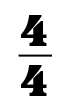 |
Four beats in a measure |
Quarter Note gets one beat |
|
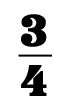 |
Three beats in a measure |
Quarter Note gets one beat |
|
 |
Cut Time |
Played twice as fast as Common Time |
|
 |
Four beats in a measure |
Same as 4/4 Time |
|
Time Signatures are found at the beginning of the song in the top left hand corner. The numbers in a time signature look like a fraction. The top number tells you the number of beats in the measure and the bottom number tells you what kind of note gets one beat.
For example in 4/4 time there are four beats per bar (top number) and a quarter note gets one beat (bottom number).
In 3/4 time there are three beats per bar (top number) and a quarter note equals one beat (bottom number).
In 2/4 time there are two beats per bar (top number) and a quarter note equals one beat (bottom number).
Anatomy of a Note

|